PROJECTS
Completed Works
Marine Tilapia Aquaculture Project
At present the FSRI is the only institution to carry the flag with a definitive plan and strategy to bring a more affordable marine cultivated fish species alternative to Cape hake to tackle food insecurity in South Africa. Seawater cultivated Mozambique tilapia presents the perfect answer being low in the food chain and economical to produce to replace increasing unaffordable Cape hake. Phase 1 of the marine cultivated tilapia project will be undertaken by the FSRI.
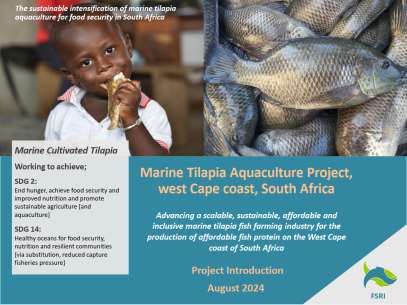

Yourtax deductible donations will go toward ensuring that the necessary seeding and catalytic work breaks the new ground to usher in sustainably cultivated seawater farmed tilapia at the FSRI and spawns a new commercial aquaculture industry in South Africa worth R4.5Bn when scaled to 100,000 tonnes per annum (=Cape hake national annual quota). Click on the Marine Tilapia Aquaculture Project, west Cape coast, South Africa cover slide to learn more.
Pilot scale Atlantic salmon RAS production unit
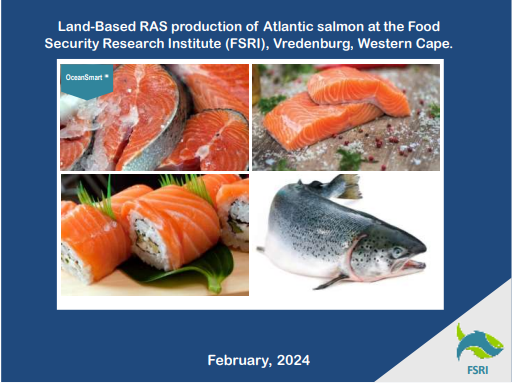
Despite very favorable returns for any Atlantic salmon farming initiatives in South Africa to replace air-freightedimports, at a premium of US$1.80/kg (about R33.33/kg) in air freight and related charges, to bring fresh fish to the South African sushi/sashimi market sourced mostly from Norway. Commercial Atlantic salmon farming has not yet taken root in South Africa apart from limited cage culture activities which present several challenges which are difficult to surmount. The answer liesin the use of land-based Recirculation Aquaculture System (RAS) technology. The high cost of imported RAS technology (mostly from Denmark and Norway) coupled with sensible pilotscaling hasrendered this opportunity difficult to initiate. The FSRI will benefit from South African RAS technology (the SAFF-RAS) developed abroad in Lebanon, Syria and Malawi but not yet developed at home. The SAFF-RAS to be deployed at the FSRI to will pave the way for private sector driven competitive and wholesome fish production for the sushi and fresh salmon market in South Africa where current imports are over 5,000 tonnes per annum worth R1Bn in air delivered fresh commodity chiefly from Norway under a high carbon footprint.
Your tax deductible donations will provide the needed funding to bridge the impossible divide by overcoming sub-optimal scale economies in a pilot scale Atlantic salmon SAFF-RAS operation which aims to provide the necessary proof-of-concept project along with system audits to lure private sector investment into a new oceans economy industrial opportunity in South Africa. Click on the Atlantic salmon RAS pilot operation cover slide to learn more.
Sea lettuce (Ulva spp) and Salicornia nutrient recovery systems
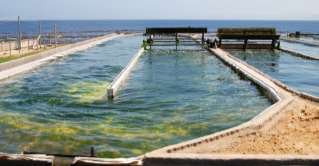
Applying an Integrated Multi-Trophic Aquaculture (IMTA) approach enables the production of sea lettuce (Ulva spp) and Salicornia spp. as inorganic extractive components cultivated on nutrified saline waste streams from fed marine tilapia and Atlantic salmon. Similarities can be drawn from the partial circular economy approach to waste valorisation in applied de-coupled aquaponics, enabling zero waste water discharge and maximum nutrient recovery via the harvest of edible marine seaweed and sea vegetables for both fish and man.
Your tax deductible donations will pave the way for nutrient recovery systems which are included in both the Marine Tilapia Aquaculture Project(MTAP) and Atlantic salmon RAS pilot operation.