
The sustainable seafood movement is gaining traction outside of North America and the EU markets in South America, the Middle East, Australasia, South Africa and the greater part of Asia among more formal markets, supermarket multiples and restaurant chains. A common theme among seafood rating NGOs is the promotion of seafood consumer guides. These typically provide a list of best or recommended choices, best alternatives or lets “think twice”, and lastly an avoid list of fish species and/or sources guiding consumers away from unsustainable seafood choices. The “Seafood Watch Program” in the US and the “Good Fish Guide”, an initiative of the Marine Conservation Society (MCS) in the UK, have in addition embraced a more holistic approach in their seafood rating guides to include food safety and
consumer protection, animal welfare and violations of labour standards through third party sustainably produced and responsibly farmed certification(s).
The most prominent certification schemes include the Aquaculture Stewardship Council (ASC), Best Aquaculture Practices
(BAP) and GLOBALG.A.P. Supplemented by Friend of the Sea add-on labelling.
Globalisation and a wave of negative publicity in the net pen salmon farming sector in Canada and Chile, i.e. stock escapes, habitat damage, water pollution and algal blooms, has spilled over affecting the ratings of tilapia cage farming in the tropics. The Good Fish Guides advisory to consumers in the UK for instance is to make sure the tilapia they buy are Aquaculture Stewardship Council (ASC) certified or originate from more sustainable Recirculation
Aquaculture Systems (RAS).
Sustainably forms the cornerstone of the “Good Fish Guide” guided by production methods which reduce negative environmental impacts (e.g. discharges,
escapes, transfer of disease and parasites, habitat damage and water pollution or degradation) associated with other culture systems such as open net pen/cage culture and pond systems. Similarly, farmed tilapias raised in Recirculation Aquaculture Systems (RAS) worldwide have been ranked “Best Choice” by the Seafood Watch, an initiative of the Monterey Bay Aquarium, which aims to help consumers and businesses make ocean-friendly seafood choices using
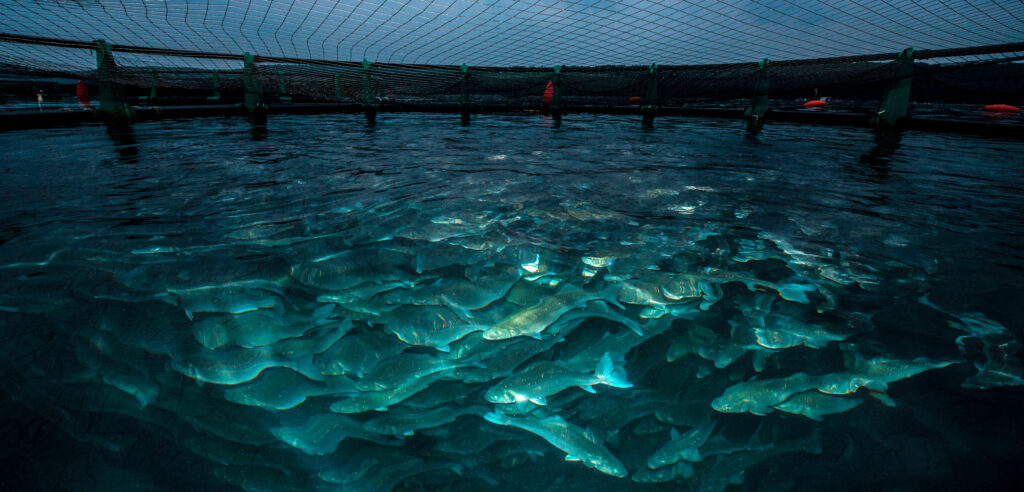
science-based recommendations. Conversely, tilapia originating from net pen or cage farms in pristine lakes whether in. Indonesia or Guatemala ranks as “Good Alternatives” by the Seafood Watch Program. Although
much of the best quality tilapia originates from net pen farming in pristine tropical lakes where the environmental costs are not counted nor passed onto consumers nor recovered by resident lakeshore communities, nor taxed by regulatory authorities. What is evident is that a well managed cage-farming operation which may acquire BAP or ASC certification subsequently might not score as the best seafood choice by the Good Fish Guide or by Seafood Watch. Clearly, in recent times the globalisation of the sustainability
Movement has begun to reward more sustainable fish farming operations commanding premiums for greener tilapia derived from more sustainable farming systems. Viewed either as a liability or opportunity, tilapia producers the world over, need to adapt to capture consumer trust and market share to access more rewarding local and international markets,
or alternatively suffer relegation to less rewarding local informal markets in the developing world.
Green growth opportunities
To counter the deleterious environmental effects of aquaculture growth, expected to more than double by 2050 from 2012. Production levels, the World Resources Institute (WRI) in 2014 issued a plea for aquaculture development to abide by a set of
directives in their report entitled, “Improving productivity and environmental performance of aquaculture”. Increased investment in technological innovation and transfer, and the promotion of low-impact production systems, are among the major themes advocated by WRI who first coined the term sustainable intensification.
Meeting the appeal of discerning local urban markets, and also highly regulated international markets, will increasingly require a shift on the part of producers to embrace “certifiable sustainable intensification” aquaculture systems such as RAS,
Biofloc Technology (BFT), aquaponics technologies, Integrated Multi-Tropic Aquaculture (IMTA) and systems which include integration into irrigation schemes. Low impact “sustainable intensification” systems perform well across most indicators
of productivity and environmental performance, ease resource constraints and can reduce food-miles given their placement flexibility capability.
Food safety is another concern. Tilapia produced using biosecure RAS at Blue Ridge Aquaculture in Virginia, US and large-scale BFT in Malawi by Chambo Fisheries
have shown that it is entirely possible to raise fish without the use of antibiotics or hormones, and free of mercury (undetectable levels) and other industrial pollutants. Green growth opportunities in tilapia aquaculture present exciting opportunities across the globe, several of which are introduced here.
A decoupled aquaponics system enables both the fish rearing and the vegetable production components to operate at their respective optimum water temperatures increasing placement flexibility into temperate climates. The bridge between the RAS or BFT includes an anaerobic digester to enable sludge digestion and mineralisation followed by the use of a Moving Bed Biofilter (MBB) to reduce nitrogenous compounds into usable nitrates and other plant nutrients for the aquaponics
component. Large-scale decoupled RAS aquaponics systems, using rafts,
are being developed in South Africa (Figure 3) and elsewhere. Similarly, a collaborative US-Brazilian research effort published in 2017 compared BFT and RAS aquaponics.
Results indicated superior leafy green vegetable production using waste streams from BFT over RAS for the production of three varieties of lettuce Lactuca sativa: red lettuce, butter lettuce, and crispy lettuce. In the next few years we are likely to see large-scale tilapia production using decoupled hydraulic water-driven vertical
aquaponics systems such as those developed by Sky Greens for hydroponically grown fresh produce in Singapore in urban.
and peri-urban settings. Accelerated urbanisation, particularly in the developing
world, will provide a ready market for sustainably produced chemical free
tilapia and leafy green vegetables. Chemical free aquaponically grown produce
usually attracts premiums in the marketplace offering excellent green growth
opportunities for tilapia and vegetable production close to urban centres.

Industrial integrated tilapia farming systems
RAS and BFT tilapia production, due to their reduced waste streams and
conservative use of freshwater, offers attractive integration opportunities where
cropland irrigation is practiced in the tropics and warm arid regions replacing or
reducing the use of chemical fertilisers.
Similar approaches to those being developed for decoupled aquaponics systems
would allow for the inorganic extractive use of RAS and BFT waste streams
via the production of a myriad of irrigated crops. The practice of using water
for fish production followed by cropland irrigation has become widespread in
arid Middle East countries, such as Egypt and Israel, offering a blueprint for
commercial agriculture-aquaculture projects the world over.
Marine cultivated tilapia – the new frontier for tilapia culture
Since the late 1980s Taiwan has almost silently capitalised on the Japanese
niche market for sushi-sashimi quality tilapia, one up on first grade exportable
freshwater reared tilapia, also known as izumidai. The practice involves the
movement of near market ready freshwater reared tilapia into marine net pens
where they are finished in seawater for a month or so to improve flavour quality
and rid fish of freshwater parasites. Taiwanese farmed izumidai tilapia is a prized
product in Japan and commands a premium price which trickles down to good
rewards for producers collecting on average US$12.00/kg of fillets over the last
10 years or so.
Apart from the Japanese market, favourable reports have emerged from
studies conducted in Puerto Rico where Florida red tilapia, a complex hybrid
reared in seawater, were marketed and by exploratory market feedback of sea
water farmed hybrid tilapia in Gulf of Panama. Consumers ranked marine cultivated Florida red tilapia highly in terms of taste, texture, freshness and presentation equal to or better than silk snapper, Lutjanus vivanus, a popular marine food fish in Puerto Rico commanding similar market prices.
Work in South Africa on the development of pure breeds of the euryhaline species,
Mozambique tilapia, raised in sea water in what is believed to be a project of strategic food security for the country is set to begin in 2018. Mozambique tilapia is indigenous to South African rivers and estuarine waters along the east coast and has shown to be the most salt tolerant of all the tilapia species.
International markets, apart from Japan and more discerning urban markets the world over, have for the most part been deprived of the opportunity to sample best quality sea water farmed tilapia as well as izumidai products for sushi bars. In fact, a second tilapia farming revolution is prognosticated following the development of tilapia breeds capable of performing well in full-strength seawater (35ppt) given their improved flavour quality and marketability. The Centre for Economic and Management of Aquatic Resources (CEMARE) scientists at the University of Portsmouth (UK) speculated that the development of vertically integrated large-scale operations coupled with low production costs at the higher technological end in

tilapia culture may lead to the evolution of an industrial concentration similar to
that witnessed in farmed Atlantic salmon. This may well prove to be the case in
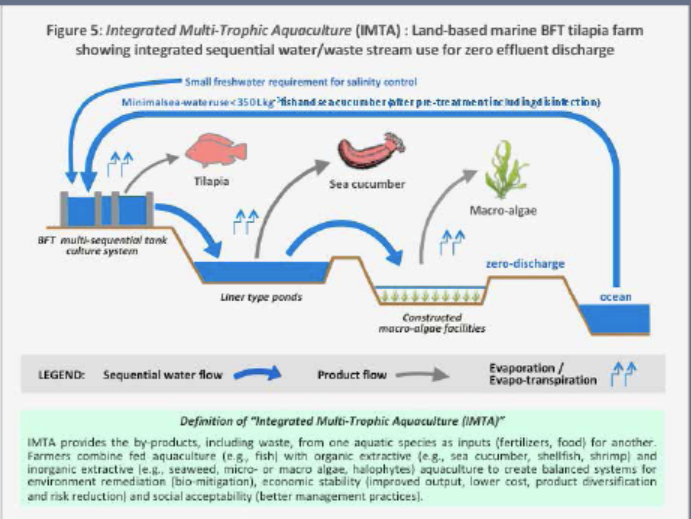
marine cultivated tilapia due to improved flavor and marketability. The real prize lies in the use of Biofloc Technology (BFT) raising hybrid red tilapia, or Mozambique tilapia, which perform well in sea-water, within a land based IMTA raising valuable organic and inorganic extractive species specifically engineered and purposed for nutrient
recovery (Figure 5). In a pioneering effort, work is under way to initiate a
land-based BFT-IMTA industry raising Mozambique tilapia in South Africa.
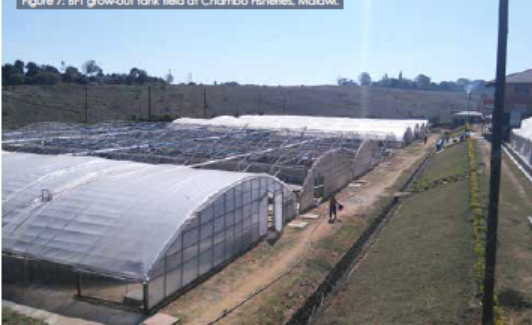
BFT capitalises on the apt filterfeeding ability of tilapias to recover microbial protein and nutrients via grazing on ‘heterotrophic plankton’ (collectively called biofloc) undoubtedly the perfect ‘miracle’ fish for BFT tank culture. Large-scale BFT tank culture in Malawi of both Mozambique tilapia (Oreochromis mossambicus) and Shiranus tilapia (Oreochromis shiranus) proved the merits of the technology. Results under large-scale commercial conditions were more than satisfactory.
Using bioenergetic feeding rate models to establish optimum feeding levels
the project realised Feed Conversion Ratios (FCRs) averaging 1:1 feeding a 20.2 percent protein ration which approximates Carbon: Nitrogen Ratios of 15.5:1 required to ensure a largely heterotrophic community dominance of the ammonia immobilisation pathway in BFT systems.
tilapia culture may lead to the evolution of an industrial concentration similar to
that witnessed in farmed Atlantic salmon. This may well prove to be the case in
marine cultivated tilapia due to improved flavor and marketability.
The real prize lies in the use of Biofloc Technology (BFT) raising hybrid red tilapia, or Mozambique tilapia, which perform well in sea-water, within a land based IMTA raising valuable organic and inorganic extractive species specifically engineered and purposed for nutrient recovery (Figure 5). In a pioneering effort, work is under way to initiate a land-based BFT-IMTA industry raising Mozambique tilapia in South Africa.
BFT capitalises on the apt filterfeeding ability of tilapias to recover microbial protein and nutrients via grazing on ‘heterotrophic plankton’ (collectively called biofloc) undoubtedly the perfect ‘miracle’ fish for BFT tank culture. Large-scale BFT tank culture in Malawi of both Mozambique tilapia (Oreochromis mossambicus) and Shiranus tilapia (Oreochromis shiranus) proved the merits of the technology.
Results under large-scale commercial conditions were more than satisfactory.
Using bioenergetic feeding rate models to establish optimum feeding levels
the project realised Feed Conversion Ratios (FCRs) averaging 1:1 feeding
a 20.2 percent protein ration which approximates Carbon: Nitrogen Ratios of 15.5:1 required to ensure a largely heterotrophic community dominance of the ammonia immobilisation pathway in BFT systems.
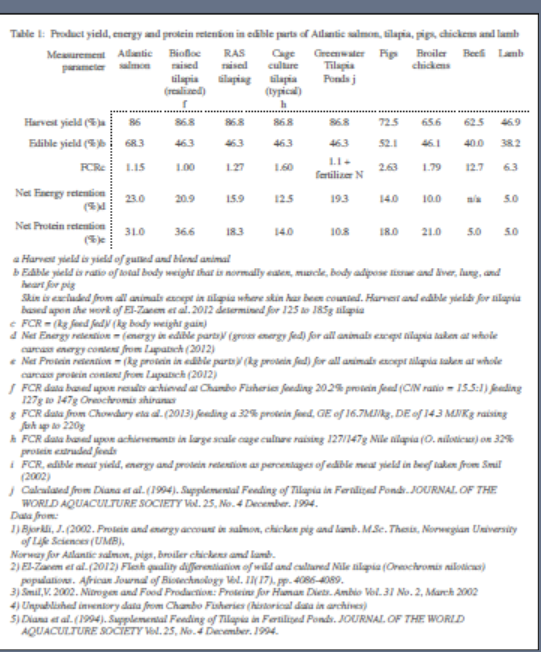
Table 1 illustrates the advantage of biofloc raised tilapia at Chambo Fisheries achieving impressive performance metrics notably 36.6 percent Net Protein Retention (NPR) and 20.9 percent Net Energy Retention (NER) on an edible meat yield
basis. Biofloc tilapia production is then over 100 percent more efficient when gauged against Net Protein Retention (NPR) values of tilapia raised in a RAS system and 162 percent more efficient than lake cage culture as reported in Table 1.
These results would suggest that properly managed biofloc tank culture of tilapias is potentially the most efficient form of feedlot livestock production. It outperforms lamb, broiler chickens, pigs and beef steers as well as feedlot aquaculture systems raising Atlantic salmon in net-pens, and tilapia under typical lake cage culture, greenwater pond farming and RAS conditions in terms of protein recovery on an edible yield basis