
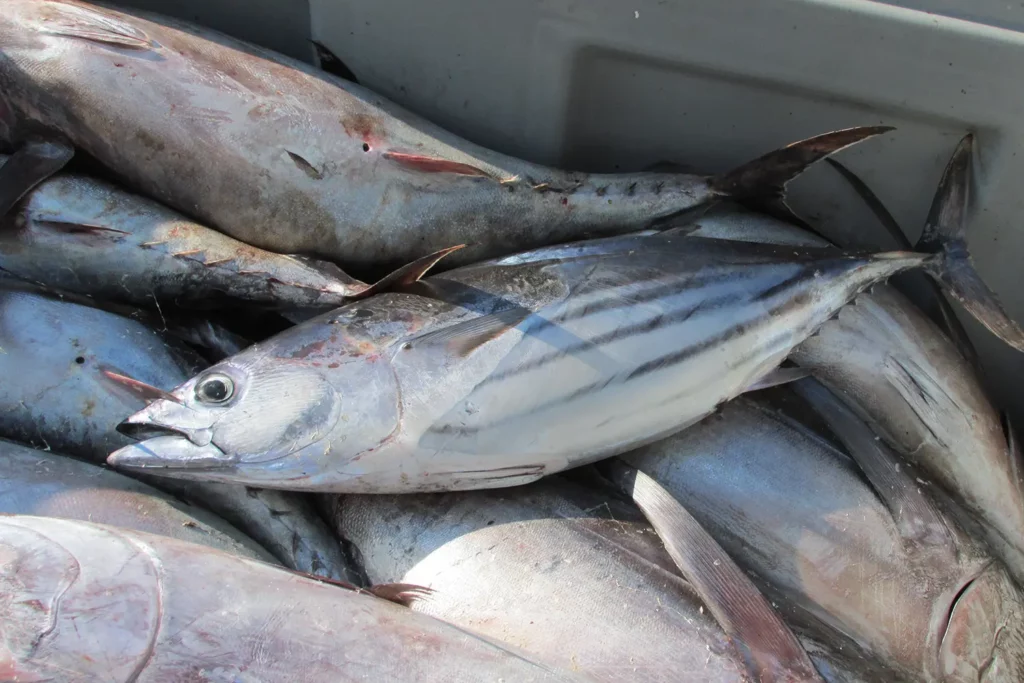
Despite a significant annual Cape hake quota that fluctuates from around 100-140 thousand t/yr in South Africa, fish has become increasingly unaffordable for most food insecure households (THAPI Aqua-Kulcha 2021a). Wholesale prices of Cape hake, South Africa’s most favoured fish and chips choice, have climbed in recent years to above R45/kg (R15 = US$1) on a whole-weight basis. Similarly, retail prices of tinned pilchards, a national favourite food basket item, have climbed above R60/kg on a drained weight basis, putting food insecure households increasingly at risk of not being able to acquire adequate omega-3 fatty acids in their diets.
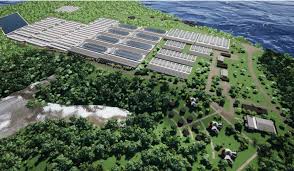
Building on a concept vision sourced from private innovators — THAPI Aqua-Kulcha — identified through an open call for expressions of interest in 2019, the Eastern Cape Rural Development Agency (ECRDA) has taken the lead to address this undesirable fish supply situation by taking aim at an ambitious project to domesticate the local Mozambique tilapia Oreochromis mossambicus species for seawater culture in a project called the Marine Tilapia Industry (MTI).
Over and above the MTI project being a response to a hake market that will grow more constraining in affordability, along with the threat of diminishing ocean stocks from marine catches, this project aims to take advantage of the natural bounty that is the endowment of South Africa’s temperate seaboard stretching along the coastline of the Eastern Cape and KwaZulu-Natal provinces.
The ambition is to establish and develop a veritable value chain for an industry that is intended to grow to a scale of 100,000 t of marine cultivated tilapia by 2035 (THAPI Aqua-Kulcha 2021b). The growth trajectory maps the course of an industry that will start with the establishment of a Marine Tilapia Industry Incubator in Mbhashe (MbMTII) as the base for growing a range of commercial clusters along the coastline of the Eastern Cape and KwaZulu-Natal over the years.
Mbhashe MarineTilapia Industry Incubator (MbMTII)
The MbMTII will be situated at the Mbhashe Local Municipality coastline with a clear set of seeding and catalytic output objectives, including improved genetic lines of pure breeds of Mozambique tilapia and an ongoing human resource development program to feed into the commercial growth phases to follow.
Why Tilapia and why Mozambique Tilapia in Particular?
Mozambique tilapia are indigenous to the east coast territory of the Eastern Cape and KwaZulu-Natal and as such the commercialization of marine tilapia aquaculture poses no biodiversity risks to endemic fish fauna. Mozambique tilapia are a low trophic level species with a highly efficient digestive system capable of good growth on animal-free, all-plant based feeds, therefore contributing to the alleviation of food insecurity due also to their low-cost production.
Mozambique tilapia grow 1.66-2 times faster in seawater than they do in freshwater (Howerton et al. 1992, Kuwaye et al. 1993, Ron et al. 1995, Shepard et al. 1997, Sparks et al. 2002). Palatability of tilapia is improved when grown in seawater, on par with the best line fish, offering improved meat texture and flavour properties and therefore greater marketability. Sold as a marine fish, seawater-farmed Mozambique tilapia overcomes market biases favouring the consumption of marine fish in South Africa (Head et al. 1994, Infofish 2003, Fraga et al. 2015, Cheng et al. 2019, Cheng et al. 2020)
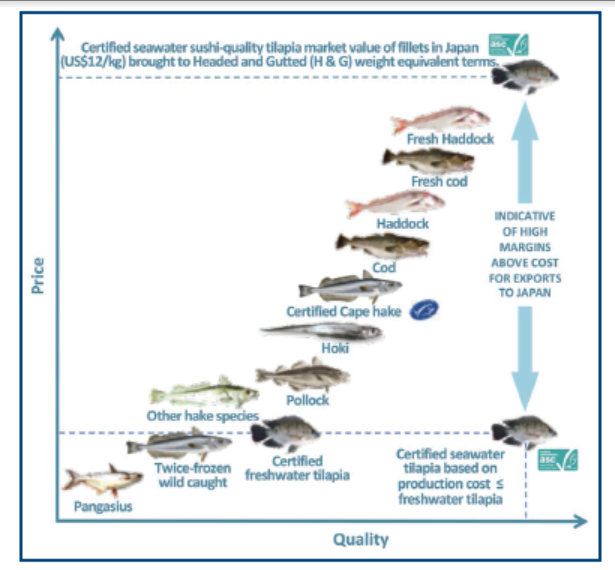
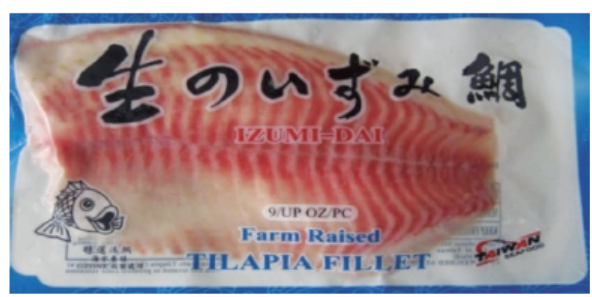
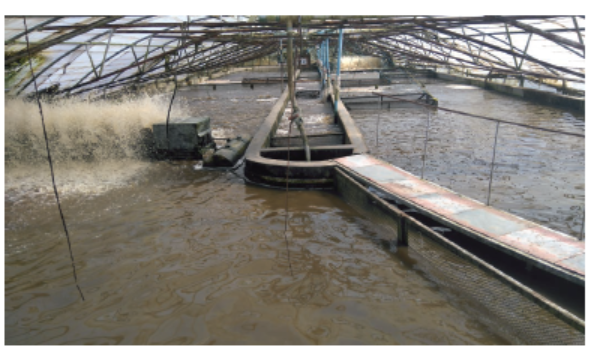
Taiwanese marine farmed tilapia fetch a premium price of US$12/kg for fillets in Japanese sushi markets, where seawater-farmed tilapia hybrids are called izumidai (Infofish 2003) and are sold for a price that is about 80 percent higher than the retail price of Cape hake fillets. (See Figure 3 for perceived price-quality rankings of the major whitefish species.) Exports from a future east coast marine tilapia industry are not among the objectives of the THAPI Marine Tilapia Vision 2035. The marketing of higher-quality marine-cultivated tilapia aims to leverage market share rather than higher local prices or exports.
A fairly sanguine outlook prognostication can be expected for this new farmed whitefish industry based upon the seawater culture of Mozambique tilapia over that of freshwater farmed tilapia due to several added advantages apart from improved texture and flavor properties:
1) Based on several studies, Mozambique tilapia use feed more efficiently, capable of achieving lower Feed Conversion Ratios in seawater over freshwater farming systems (Ron et al. 1995, Iwama et al. 1997, Barreto-Curiel et al. 2015). These advantages are further amplified by the use of Biofloc Technology (BFT) with seawater. Using all-plant based feeds with a lower protein content of just 20 percent, FCRs are anticipated to be lower than around 1, as achieved in freshwater BFT systems in Malawi (Kourie 2017b).
2) Reduced energy inputs of 1.05kWh/kg of farmed tilapia production output in seawater can be attributed to a higher alpha factor of 2.5 for sub-surface aeration (in comparison with a freshwater α factor of 0.92-1.0) at sea level and salinities of 32-36 ppt (Boyd and Watten 1989, Ruttanagosrigit et al. 1991, Fast et al. 1999). The main air blowers used to furnish air for diffused airlift aerators in seawater would require 29.2 kW (1.02 kWh/kg of tilapia produced) as opposed to 39.8 kW (1.40 kWh/kg of.
tilapia produced) in a 250-t freshwater, multi-cohort, sequentially managed BFT tank system.
3) Efficient use of capital for infrastructure based upon an optimized design philosophy (proven on a large scale in Malawi) applying a multi-cohort sequential production schedule that improves production throughput capacity by almost 50 percent on an annualized basis under similar capital expenditure outlays (Kourie 2017a, 2017c).
4) Upstream and downstream scale and scope economies and the beneficial effects of specialization including a reduced gestation period from investment to first income.
5) More efficient use of labour and management, an effect of farm size and the manageability of fewer larger-scale grow-out production units (20 tanks each producing 250 t annually = 5,000 t/yr per grow-out farm).
The value proposition in the development of a scalable and competitive marine tilapia farming industry in South Africa hinges on the use of reduced-input, all-plant based, low-protein feeds and BFT aquaculture tanks placed under greenhouse enclosures to capitalize on solar heat gains to enhance productivity (unit production/unit volume or surface area) and hence capital employed in farm infrastructure under reduced land area requirements.
Farm gate production costs for large-scale BFT Mozambique tilapia aquaculture in seawater systems are anticipated to be
around R15/kg (US$1/kg) before sales to a dedicated processing plant serving four 5,000 t/yr grow-out farms (THAPI Aqua-Kulcha 2021b).
Marine Tilapia Farming in South Africa: A Niche Market Opportunity or the Answer to Food Insecurity?
finding it increasingly difficult to put affordable animal protein sources into their daily dietary regimes, not least because of the impacts of the COVID-19 pandemic and rising food prices. Excluding tinned pilchards, around 2005-2006, broiler chickens took the crown from marine capture fisheries to become the least-cost animal protein source in the country. This is despite the large price spreads, ranging from 50-100 percent, between the large-scale producer cost at the base of the broiler chicken value chain and that of the supermarket retail price, hovering around R45-55/kg (VAT inclusive) in 2021 for frozen dressed birds in recent times (THAPI Aqua-Kulcha 2021a). Although there appears to be economic opportunity for small- to medium-scale broiler producers, despite higher feed, abattoir and other input costs for direct retailing to consumers, by-passing the formal value chain. Using the small-scale producer cost model, our estimate puts the ex-abattoir cost of broilers at R29-31/kg of live bird (THAPI Aqua-Kulcha 2021a). We used R30.22/kg of live bird following added abattoir costs converted to an edible meat yield at 46.1 percent in Figure 6.
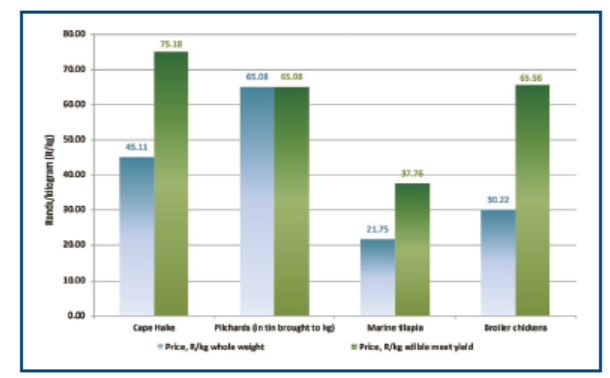
Beef, lamb and pork cannot compete with the price of from the most appropriate cost comparison to establish the food security value proposition of the various animal protein sources brought to an edible meat yield basis. Figure 6 provides an account of the whole weight and edible meat yield pricing of broiler chickens (small-scale, farm-consumer sales), Cape hake, tinned pilchards (net or drained weight, brought to 1 kg) and that of marine-farmed tilapia using a large-scale BFT approach (THAPI Aqua-Kulcha 2021a).
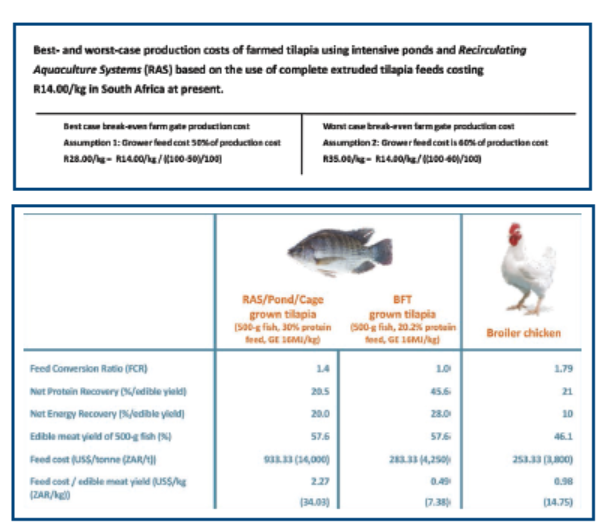
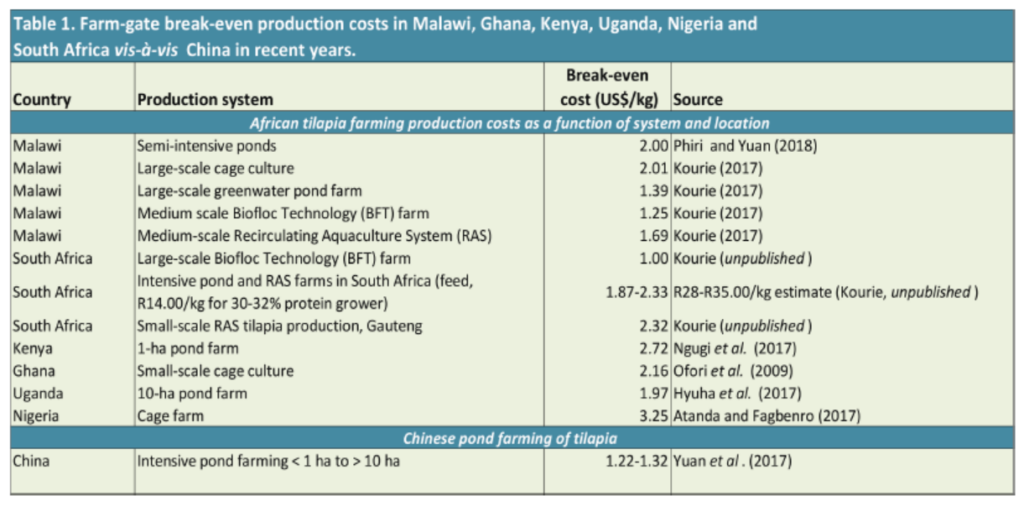
Figure 6 indicates that a large-scale marine tilapia industry could provide consumers in the rural Eastern Cape and KwaZulu-Natal with affordable fish at R37.76/kg edible meat yield, offering unrivaled food security impact potential. That is about half the cost of Cape hake (R75.18/kg) and less than two-thirds of the cost of tinned pilchards (R65.08/kg) and less than two-thirds of the cost of broiler chickens (R65.56/kg), all on an edible meat yield pricing basis (Figure 6) (THAPI Aqua-Kulcha 2021a). The current tilapia farming production philosophy based upon the use of intensive pond farming and Recirculating Aquaculture Systems (RAS) and complete extruded aquatic feeds at a cost of R14.00/kg for a 28-32 percent protein grower feed, puts the farm-gate, break-even production cost in the R28/kg (best case) and R35/kg (worst case) producer price range, which is then uncompetitive against large-scale broiler producer costs (ca. R21-23/kg, SAPA 2019) at the base of the value chain, also the preferred meat choice nationally. Clearly winning the substitution challenge when the farm-gate, break-even producer costs are much above R20/kg for farmed tilapia on a live-weight basis is a tall order, offering little merit as an affordable alternative meat protein targeting food insecure households in rural and urban South Africa.
The major cost drivers and challenges confronting the fledgling tilapia farming sector in South Africa are 1) high feed cost (> R14/kg for 28-32 percent protein grower rations), 2) sub-optimal water temperatures most of the year (Fig. 8) due to the poor location of
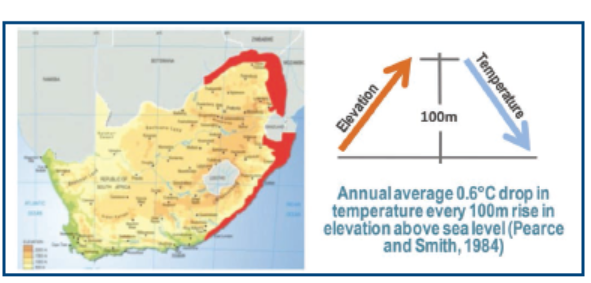
warmer east coast and low elevation inland sites (still climatically sub-optimal for efficient tilapia culture for water temperatures above 25 C for more than three months of the year), 3) the use of inappropriate production technology for low-cost and scalable production viz. intensive pond farming and RAS and, 5) lack of scale and scope economies of operations (THAPI Aqua-Kulcha 2021b). The future large-scale farmed production of Mozambique tilapia in seawater, or marine-farmed tilapia using BFT, applying today’s costs and pricing in 2021 clearly represents potentially the least-cost animal meat protein source in South Africa (Figs. 6 and 7).
Comparing Tilapia with Broiler Chicken Production
Figure 7 provides an accounting of the efficiency of feed use in BFT tilapia aquaculture as compared to intensive pond farming and the use of a RAS in tilapia aquaculture versus broiler chicken farming. BFT tilapia production competes favourably against broiler chicken farming in terms of feed use efficiency accounting on both a live weight and edible meat yield basis. Tilapia culture using either intensive ponds (> 7 t/ha yr) or RAS tilapia production technology.
would not be competitive in terms of feed use efficiency when gauged against broiler chicken farming, given current pricing of standard extruded tilapia grower feeds at a cost of R14/kg ex-factory in South Africa.
The solution to the local sub-optimal climate for productive and efficient tilapia culture, high feed costs (extruded feed for tilapia costs around R14/kg for a 28-32 percent grower ration) and lack of the benefits of economies-of-scale calls for a more determined, targeted and sophisticated response to solve these peculiar challenges.
THAPI Aqua-Kulcha sees large-scale professionally managed majority worker co-owned scalable sustainable intensification of the tilapia farming sector, emulating certain elements of the highly successful broiler farming model, adapted for local sub-optimal climatic conditions and the use of BFT as key to the success of an efficient and competitive tilapia culture sector in South Africa.
The new marine tilapia industry proposed by the THAPI Marine Tilapia Industry Vision 2035 at scale producing 20,000 t of tilapia per cluster potentially offers the least-cost animal protein source in South Africa (Fig. 6) at farm-gate break-even costs as low as R15/kg (U$1/kg) live weight at the base of the value chain after the attainment of the benefits of scale- and scope economies and specialization based upon long-run costs at today’s input prices
Before onward sales to a processing plant. Then, a large-scale BFT based marine tilapia industry along the east coast would be the least-cost producer of tilapia in the country, the least-cost source of animal protein in South Africa and the least-cost producer of scalable quantities of tilapia in Africa.
Equally on the international stage the THAPI Marine Tilapia Industry Vision 2035 would be highly competitive where the farm gate break-even production costs of around R15/kg (US$1/kg) live weight (Table 1) are then some 18.4-25 percent less than break-even production costs of R18.30-19.80/kg (US$1.22-1.32/kg) for tilapia farm sizes ranging from <1 ha to >10 ha in China (Yuan et al. 2017).
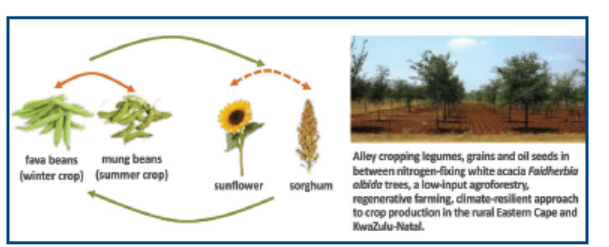
Equally significant is the positive pull effect created by the THAPI Marine Tilapia Industry Vision 2035 for feedstock raw materials that additionally provides a choice opportunity to transform available land, water and human capital for food security and income generation involving 15,000-30,000 farmer families per 20,000 t tilapia cluster in the rural Eastern Cape and KwaZulu-Natal. Five clusters are planned at Phase 5 (up to150,000 farmer families and 100,000 t of fish production) on the Eastern Cape and KwaZulu-Natal coastline. Farmers would plant feedstock crops for the Marine Tilapia Industry and also produce nutritious crops such as pulses and legumes, maize and sorghum for local/regional consumption and other markets (Fig. 9).
The THAPI Marine Tilapia Vision 2035 offers a prime opportunity to rescale developmental objectives, using new inclusive growth conduits to address the triple challenges of rural poverty, unemployment and inequality on the one hand, as well as address rural nutritional security and food sovereignty on the other hand. The vision addresses SDG 2 to end hunger, achieve food security and improved nutrition and to promote sustainable agriculture and aquaculture, and both, indirectly and directly via substitution, and supports SDG 14 which targets healthy oceans for food security, nutrition and resilient communities. Given this mission then, the THAPI Marine Tilapia Industry Vision 2035 offers one of the most attractive solutions to countering the prevalence of household food insecurity with nearly 60.6 percent and 50 percent of households dependent on social grants in 2019 (Stats SA 2020) and an official unemployment rate of 47.9 percent and 29.6 percent (Stats SA 2021) in the rural Eastern Cape and KwaZulu-Natal, respectively, over the period October-December 2020.

Ramon M. Kourie
Chief Technical Officer
SAFF - SustAqua Fish Farms (Pty) Ltd
14 Branch Lane, Blairgowrie, 2625
Johannesburg, South Africa
http://sustaquafishfarms.co.za
ramonkourie@sustaquafishfarms.co.za